Abstract
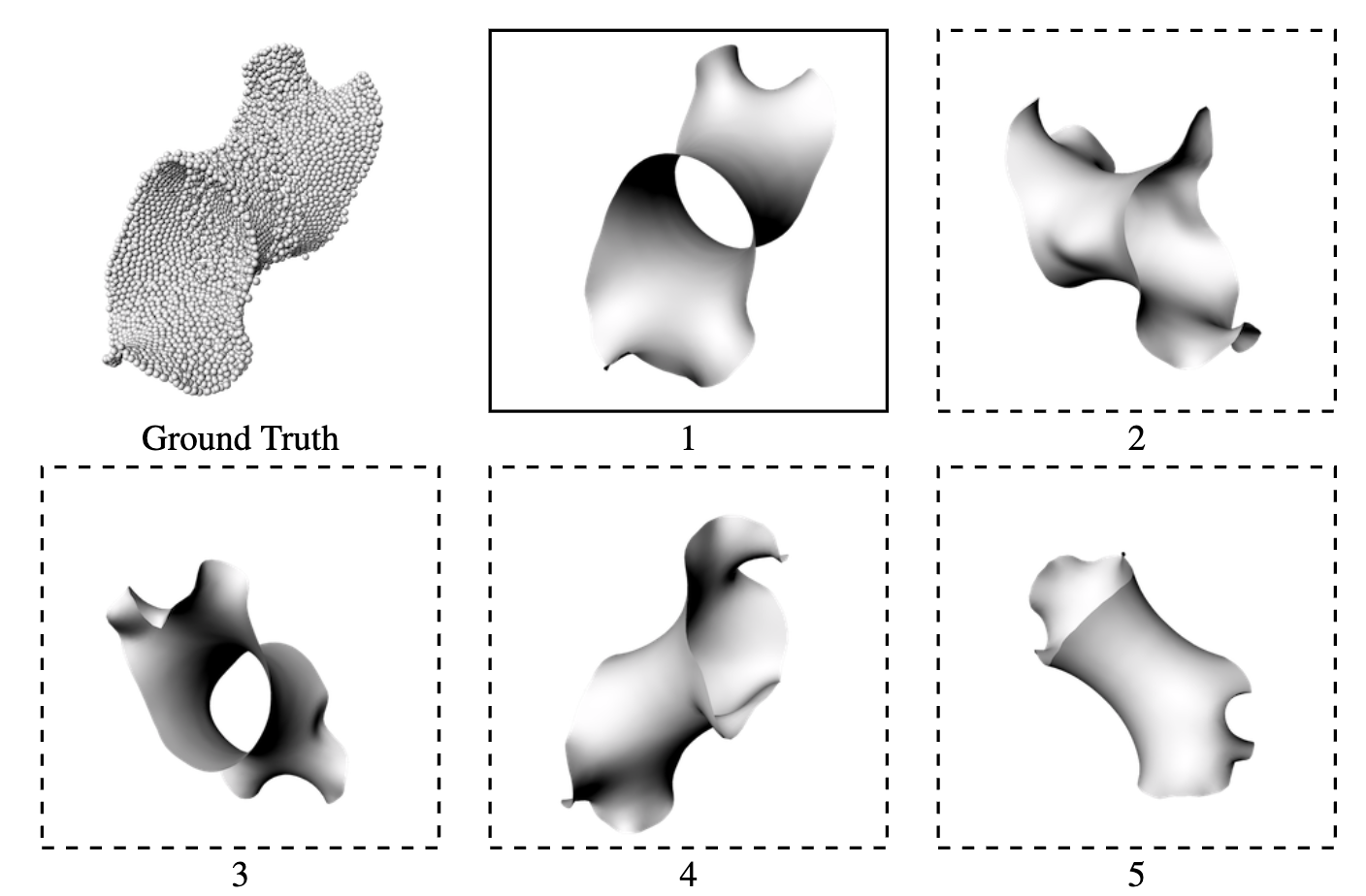
Many physical systems do not merely move or deform; they grow, adding material
and changing the geometry that a world model must represent. Existing world
models are typically optimized for pixel prediction, reward prediction, or
fixed-support physical dynamics, leaving open how to model systems whose
underlying physical support expands over time and whose future morphology
depends on hidden material response.
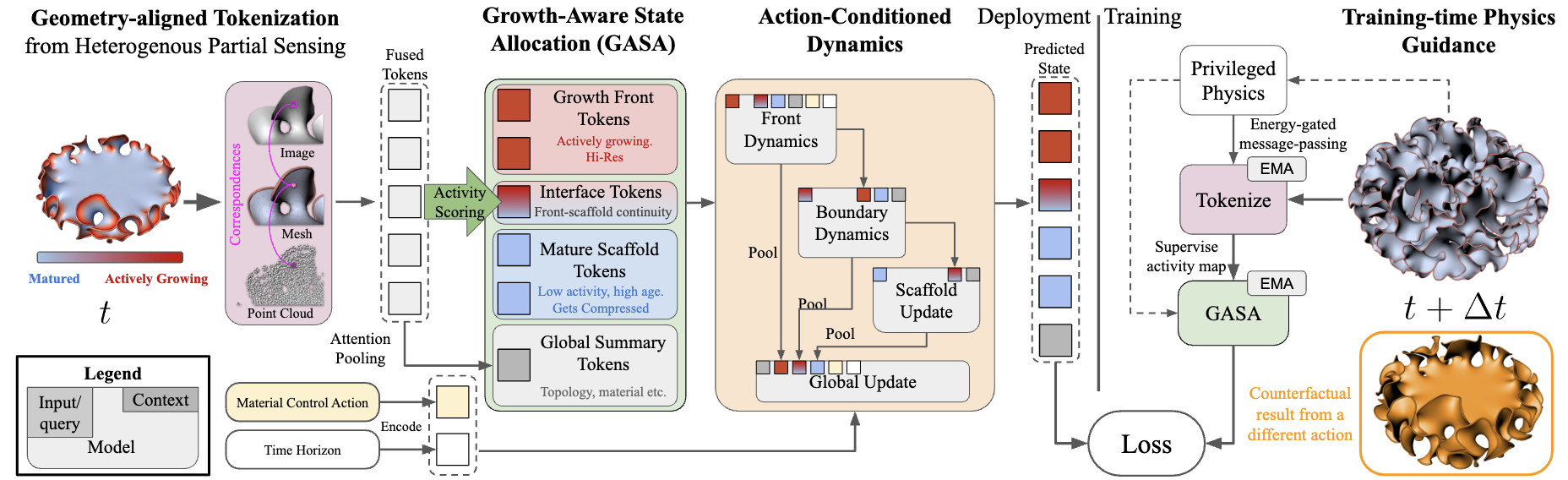
We introduce FOLIAGE, a geometry-centered latent world model
for growing surfaces. Within a fixed state budget, FOLIAGE represents mature
regions as a compact scaffold while allocating higher-resolution state to
regions predicted to drive near-future growth. This focuses representation
and computation where new material and geometric change occur while retaining
compact global context.
FOLIAGE further separates observation, action, and privileged physics:
heterogeneous RGB, point-cloud, and mesh observations are fused into a
deployable geometric state; material controls condition the latent dynamics;
and hidden physical energies guide training but are not required at deployment.
To evaluate this setting, we introduce SURF-GARDEN and
SURF-BENCH, providing controlled counterfactual branches,
dense cross-modal correspondences, hidden physical signals, and stress tests
for growing-geometry state learning.
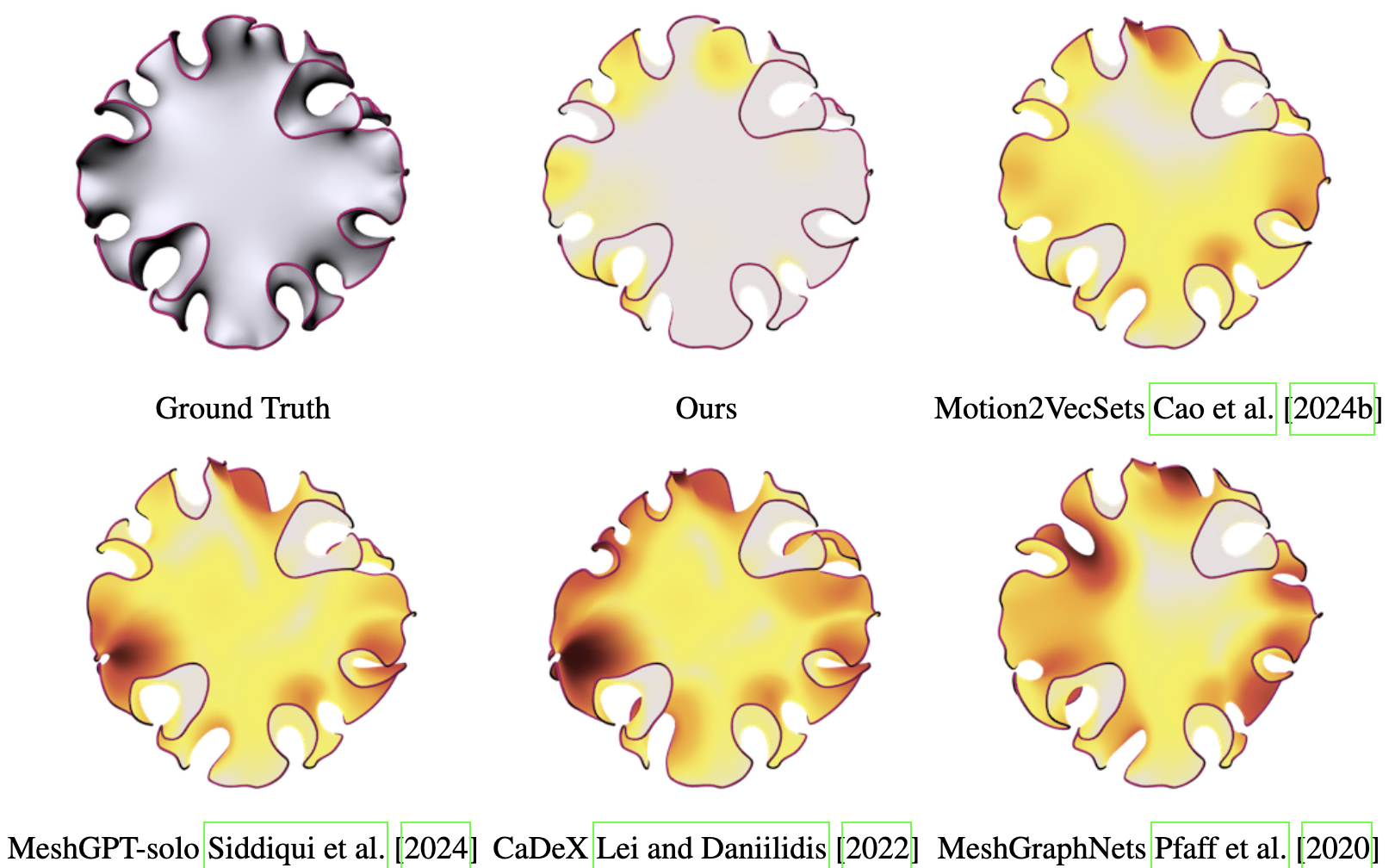
FOLIAGE reduces inverse-material error by approximately 40%
and 5-step mesh-forecasting Chamfer error by approximately
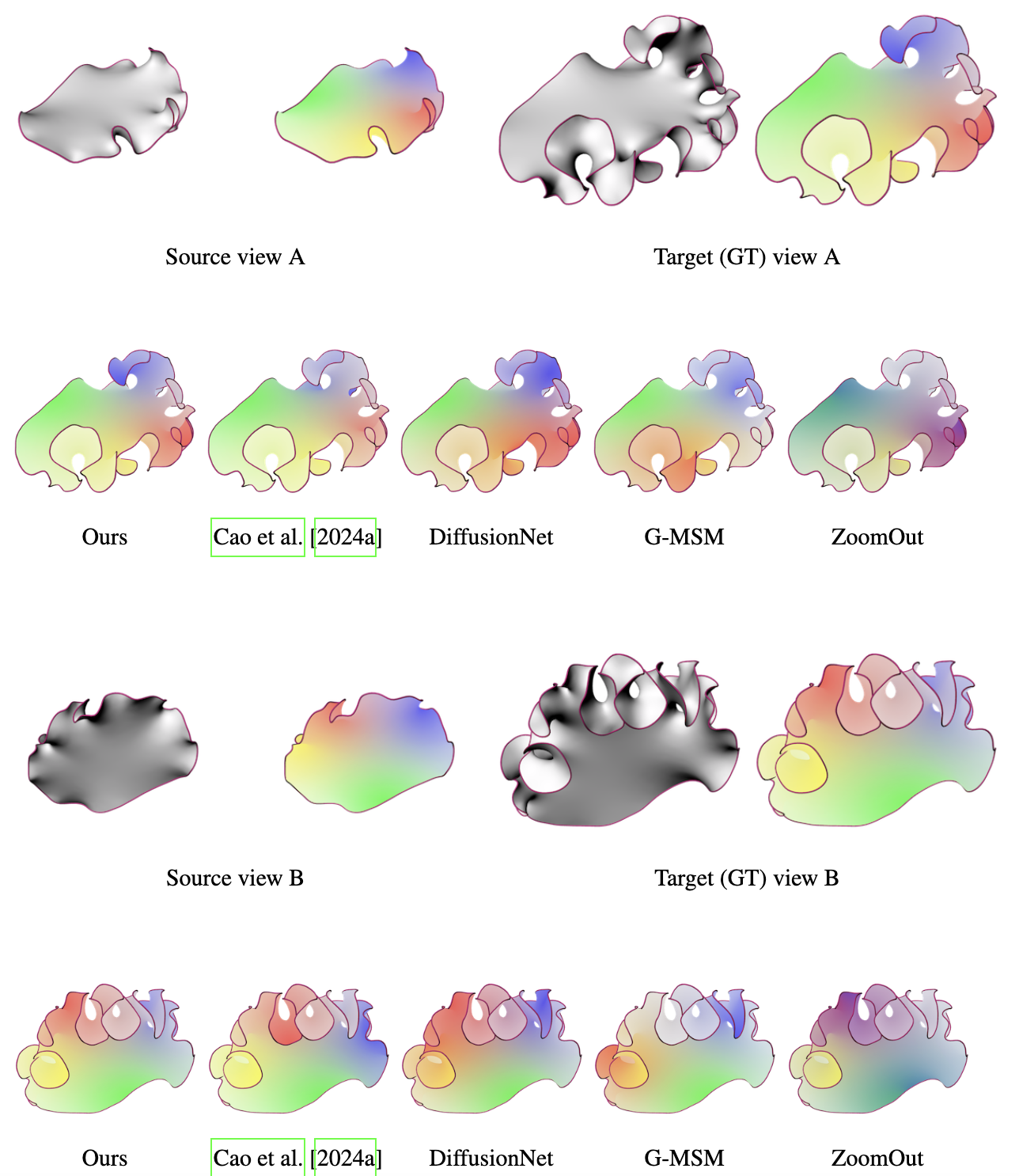
30% relative to strong baselines, while improving cross-modal
retrieval by 14 mAP points. Stress tests show graceful
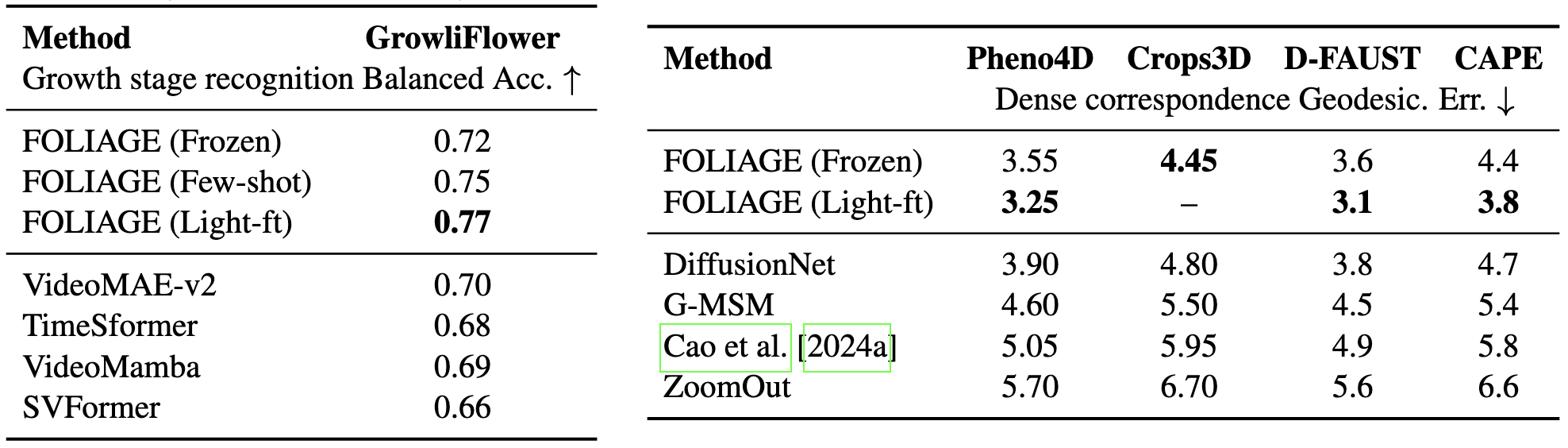
degradation under sensor loss and correspondence corruption. On temporal 3D
plant scans, FOLIAGE also improves passive future-geometry forecasting, while
transfer experiments show that the learned geometry-centered state remains
useful beyond the simulator.